
-
 Belgian Chocolate | 2.5kg
Anabolic Mass Gainer with Ultrasorb Tech | No Maltodextrin | Belgian Chocolate | 2.5 kg
Regular price ₹2,199Sale price ₹2,199 Regular priceUnit price per₹3,91443% OFF43% OFFSale -
 Strawberry Banana | 2.5kg
Anabolic Mass Gainer with Ultrasorb Tech | No Maltodextrin | Strawberry Banana | 2.5 kg
Regular price ₹2,199Sale price ₹2,199 Regular priceUnit price per₹3,91443% OFF43% OFFSale -
 Malai Kulfi | 2.5kg
Anabolic Mass Gainer with Ultrasorb Tech | No Maltodextrin | Malai Kulfi | 2.5 kg
Regular price ₹2,199Sale price ₹2,199 Regular priceUnit price per₹3,49937% OFF37% OFFSale -
 Belgian Chocolate | 1kg
Anabolic Mass Gainer with Ultrasorb Tech | No Maltodextrin | Belgian Chocolate | 1 kg
Regular price ₹1,099Sale price ₹1,099 Regular priceUnit price per₹1,77938% OFF38% OFFSale -
 Strawberry Banana | 1kg
Anabolic Mass Gainer with Ultrasorb Tech | No Maltodextrin | Strawberry Banana | 1 kg
Regular price ₹1,099Sale price ₹1,099 Regular priceUnit price per₹1,77938% OFF38% OFFSale -
Anabolic Mass Gainer with Ultrasorb Tech | No Maltodextrin | Malai Kulfi | 1 kg
Regular price ₹1,099Sale price ₹1,099 Regular priceUnit price per₹1,77938% OFF38% OFFSale -
 Belgian Chocolate | 5kg
Anabolic Mass Gainer with Ultrasorb Tech | No Maltodextrin | Belgian Chocolate | 5 kg
Regular price ₹3,799Sale price ₹3,799 Regular priceUnit price per₹7,56349% OFF49% OFFSale -
 Strawberry Banana | 5 kg
Anabolic Mass Gainer with Ultrasorb Tech | No Maltodextrin | Strawberry Banana | 5 kg
Regular price ₹3,799Sale price ₹3,799 Regular priceUnit price per₹7,56249% OFF49% OFFSale -
Anabolic Mass Gainer with Ultrasorb Tech | No Maltodextrin | Malai Kulfi | 5 kg
Regular price ₹3,799Sale price ₹3,799 Regular priceUnit price per₹7,56249% OFF49% OFFSale -
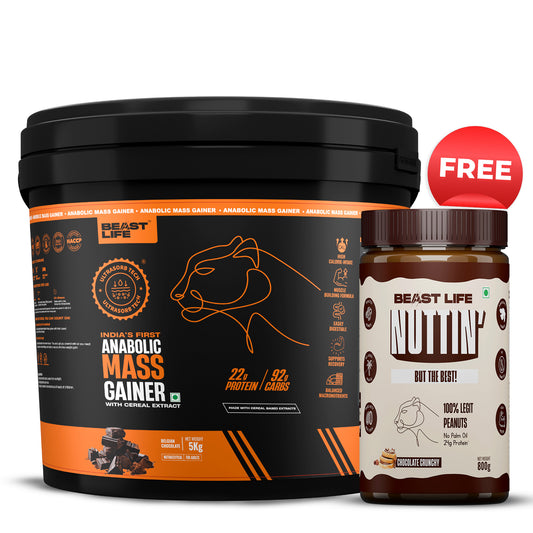 Belgian Chocolate | 5kg
Anabolic Mass Gainer with Ultrasorb Tech | No Maltodextrin | Belgian Chocolate | 5 kg with Free Peanut Butter
- Ultrasorb Tech
- No Maltodextrin
Regular price ₹4,348Sale price ₹4,348 Regular priceUnit price per₹9,14852% OFF52% OFFSale -
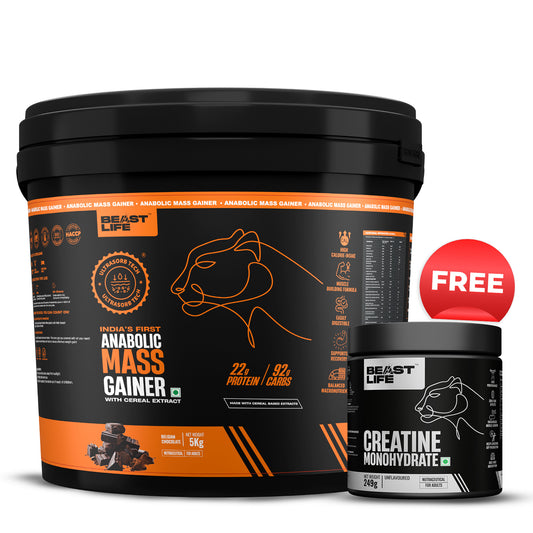 Belgian Chocolate | 5kg
Anabolic Mass Gainer with Ultrasorb Tech | No Maltodextrin | Belgian Chocolate | 5 kg with Free Creatine
Regular price ₹4,598Sale price ₹4,598 Regular priceUnit price per₹9,14849% OFF49% OFFSale -
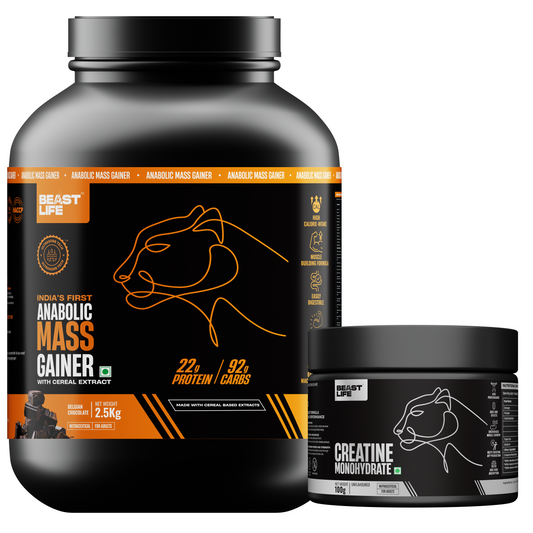 Combo Pack
Combo Pack | Anabolic Mass Gainer Belgian Chocolate 2.5 kg + Creatine Monohydrate Unflavoured 100 g
Regular price ₹2,748Sale price ₹2,748 Regular priceUnit price per₹4,58040% OFF40% OFFSale -
 Sold outNano + Mass Gainer
Combo pack | Creatine Nano 400 | Shikanji | 115 g + Anabolic Mass Gainer | Belgian Chocolate | 1 kg
Regular price ₹1,898Sale price ₹1,898 Regular priceUnit price per₹2,67829% OFF29% OFFSold out -
 Nano + Mass Gainer
Combo pack | Creatine Nano 400 | Unflavoured | 250 g + Anabolic Mass Gainer | Belgian Chocolate | 2.5 kg
Regular price ₹3,798Sale price ₹3,798 Regular priceUnit price per₹5,91335% OFF35% OFFSold out -
 Strawberry Banana 500g
Anabolic Mass Gainer with Ultrasorb Tech | No Maltodextrin | Strawberry Banana | 500 g
Regular price ₹549Sale price ₹549 Regular priceUnit price per₹97843% OFF43% OFFSale -
The DOMINANCE DUO | Gainer 2.5kg + Creatine 249 g
Regular price ₹2,898Sale price ₹2,898 Regular priceUnit price per₹5,89850% OFF50% OFFSale -
 Belgian Chocolate | 500g
Anabolic Mass Gainer with Ultrasorb Tech | No Maltodextrin | Belgian Chocolate | 500 g
Regular price ₹549Sale price ₹549 Regular priceUnit price per₹97843% OFF43% OFFSale -
THE BEAST BUILDER KIT | Gainer 1kg + Creatine 100 g
Regular price ₹1,548Sale price ₹1,548 Regular priceUnit price per₹2,74843% OFF43% OFFSale -
THE GAIN TRAIN EXPRESS | Gainer 500g + Creatine 100 g
Regular price ₹998Sale price ₹998 Regular priceUnit price per₹1,84845% OFF45% OFFSale -
Anabolic Mass Gainer with Ultrasorb Tech | No Maltodextrin
Regular price ₹1,099Sale price ₹1,099 Regular priceUnit price per₹1,77943% OFF38% OFFSale -
 Nano + Mass Gainer
Combo pack | Creatine Nano 400 | Unflavoured | 100 g + Anabolic Mass Gainer | Belgian Chocolate | 1 kg
Regular price ₹1,898Sale price ₹1,898 Regular priceUnit price per₹2,67829% OFF29% OFFSale -
 Nano + Mass Gainer
Combo pack | Creatine Nano 400 | Shikanji | 305 g + Anabolic Mass Gainer | Belgian Chocolate | 2.5 kg
Regular price ₹3,798Sale price ₹3,798 Regular priceUnit price per₹5,91335% OFF35% OFFSold out -
Anabolic Mass Gainer with Ultrasorb Tech | No Maltodextrin | Cookies & Cream | 1 kg
Regular price ₹1,099Sale price ₹1,099 Regular priceUnit price per₹1,77838% OFF38% OFFSale -
Anabolic Mass Gainer with Ultrasorb Tech | No Maltodextrin | Cookies & Cream | 2.5 kg
Regular price ₹2,199Sale price ₹2,199 Regular priceUnit price per₹3,91443% OFF43% OFFSale


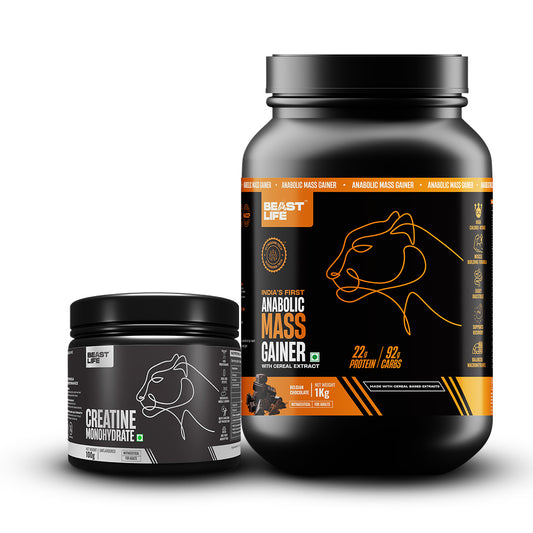
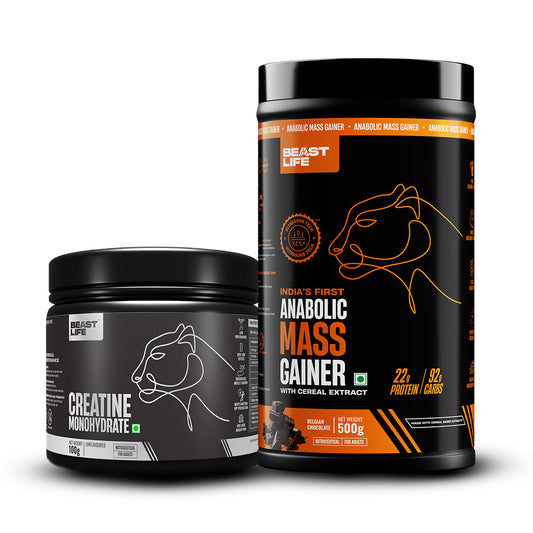


Lean Gains, Real Results: How to Identify the Best Lean Mass Gainer for Your Goals
The word "lean" on a mass gainer label is one of the most misused terms in the supplement industry. Search any supplement platform online, and you will find products claiming to be lean gainers that deliver 80 percent of their calories from simple sugars and a carbohydrate-to-protein ratio of 10:1 or higher. These products share a name with genuine lean mass gainers but deliver an entirely different nutritional outcome. The best lean mass gainer is defined by a specific macronutrient balance: a calorie structure that supports a moderate surplus for muscle development without the sugar load that drives disproportionate fat accumulation alongside muscle growth. This guide gives you the science, the criteria, and the label-reading skill set to separate genuine lean gainers from high-sugar calorie products with a more appealing brand name.
What "Lean" Actually Means in a Mass Gainer Context
In nutritional terms, "lean" in a mass gainer refers to a product formulated to support lean mass gain rather than total weight gain at any cost. The distinction is meaningful because:
- Total weight gain includes both muscle tissue and fat tissue
- Lean mass gain prioritises muscle development while limiting fat accumulation
- The macronutrient profile of the product is the primary driver of which outcome you get
A genuinely lean mass gainer typically shows:
- A carbohydrate-to-protein ratio of between 2:1 and 3:1 (compared to 4:1 to 6:1 in standard high-calorie gainers)
- Complex carbohydrates as the primary carbohydrate source, not added sugar
- 30 to 40g or more of protein per serving from quality whey protein fractions
- A moderate calorie density of 400 to 600 calories per serving
If a product claiming to be a lean gainer delivers fewer than 25g of protein per serving and more than 10g of added sugar per serving, it is not a lean gainer in any meaningful nutritional sense, regardless of what the label says.
4 Myths About Lean Mass Gainers That Cost Athletes Results
Myth 1: A Lean Gainer Is Just a Regular Gainer With Fewer Calories
Lean mass gainers are not standard products with a smaller scoop. The macronutrient balance is fundamentally different. A lean gainer delivers a higher percentage of calories from protein relative to carbohydrates, which produces a more favourable muscle-to-fat gain ratio regardless of serving size.
Myth 2: You Need a High-Calorie Gainer to Build Mass Effectively
Excess calories above your training-adjusted surplus do not build more muscle. They build fat. A moderate caloric surplus of 300 to 500 calories above TDEE, delivered through a lean gainer's macronutrient balance, supports equivalent or better lean mass outcomes compared to an 800-calorie-per-serving high-sugar gainer.
Myth 3: All Mass Gainers Produce Similar Body Composition Results
They do not. The carbohydrate source, protein percentage, and sugar content of a mass gainer directly shape the type of weight you gain. High-sugar gainers with poor protein ratios predominantly drive fat storage alongside caloric surplus. Quality lean gainers with complex carbohydrates and high protein content support a more favourable muscle-to-fat ratio.
Myth 4: Lean Gainers Are Only Relevant for People Who Are Already Lean
Lean mass gainers are appropriate for anyone whose primary goal is building muscle with controlled fat accumulation, regardless of starting body composition.
How to Read a Lean Mass Gainer Label: 6 Checkpoints
-
Protein per serving: Look for at least 25 to 35g per serving from whey protein fractions. Soy or collagen as primary protein sources are lower-quality substitutes that undermine the product's muscle-building capacity.
-
Carbohydrate source: Complex sources (oat flour, sweet potato powder, brown rice powder) support sustained energy and are less likely to drive fat accumulation. Simple sugars listed at the top of the carbohydrate source list indicate a lower-quality product.
-
Sugar per serving: Below 5g per serving is the target for a genuine lean gainer. Above 10g per serving indicates the product is not genuinely lean, regardless of its marketing.
-
Carbohydrate-to-protein ratio: Divide total carbohydrates by total protein. Genuine lean mass gainers show a ratio of 2:1 to 3:1. Above 4:1 is standard gainer territory.
-
Calorie density: Between 400 and 600 calories per serving for a lean gainer. Higher calorie densities are more consistent with standard high-calorie gainers.
- FSSAI license number: Required for all supplement products sold legally in India.
For athletes who want a dedicated high-purity protein supplement alongside their lean gainer, the whey protein isolate 1kg collection provides a lean, fast-absorbing protein option well-suited to pairing with a moderate-calorie gainer.
Who Should Choose the Best Lean Mass Gainer Over a Standard Gainer?
Lean mass gainers are most appropriate for:
- Intermediate gym-goers who have completed an initial mass-building phase and are now focused on improving body composition while continuing lean muscle development
- Athletes who are moderately lean and want to increase muscle mass without significantly increasing body fat percentage
- Individuals who experienced excessive fat gain on standard high-calorie gainers and want a more controlled approach to bulking
- People following a structured nutrition plan where macronutrients are tracked and a moderate, predictable surplus is the goal
Standard high-calorie gainers are more appropriate for significantly underweight individuals, ectomorphs with very high metabolisms, and beginners who need a large caloric intervention to begin gaining at all.
Stacking the Best Lean Mass Gainer With a Quality Protein Supplement
Many athletes use a lean mass gainer as their primary calorie and carbohydrate source and supplement it with an additional whey protein serving around training for faster amino acid delivery post-workout.
This two-product approach is effective because:
- The gainer's moderate calorie density supports the daily surplus across one or two meals without a single overwhelming serving
- A dedicated whey protein serving post-workout delivers amino acids faster than a gainer serving because lower fat and carbohydrate content means faster digestion
- Together, they cover both calorie surplus management and high-quality post-workout recovery protein
The beast whey protein range pairs effectively with a lean mass gainer programme for athletes who want targeted recovery protein alongside their surplus-support supplement. Athletes focused specifically on muscle outcomes should also review the best whey protein for muscle gain collection for comparison.
Frequently Asked Questions
Q1: What is the ideal carbohydrate-to-protein ratio in the best lean mass gainer?
A ratio of 2:1 to 3:1 (carbohydrate to protein) is the benchmark for a genuine lean gainer. Products above 4:1 are more accurately categorised as standard mass gainers.
Q2: Can I use a lean mass gainer during a fat loss phase?
No. Lean mass gainers are formulated for a moderate caloric surplus. During a fat loss phase, a high-quality whey protein supplement within a calorie-controlled diet is a more appropriate tool.
Q3: How many calories per serving should the best lean mass gainer have?
Between 400 and 600 calories per serving is the typical range for genuine lean mass gainers. This provides a meaningful caloric contribution without the excess that drives disproportionate fat gain.
Q4: Is a lean mass gainer suitable for beginners?
Yes, if the beginner's goal is controlled lean muscle development rather than rapid total weight gain. Significantly underweight beginners who need a large caloric intervention may benefit more from a higher-calorie standard gainer initially.
Q5: When should I take a lean mass gainer for best results?
Post-workout is the most recommended timing. The protein and carbohydrate combination supports simultaneous glycogen replenishment and muscle protein synthesis after resistance training.
Q6: How does a lean mass gainer differ from whey protein?
A lean mass gainer provides both protein and significant complex carbohydrates in a calorie-dense formula. Whey protein provides primarily protein with a low calorie contribution. Lean gainers support a caloric surplus; whey protein primarily supports daily protein targets within an existing calorie structure.


