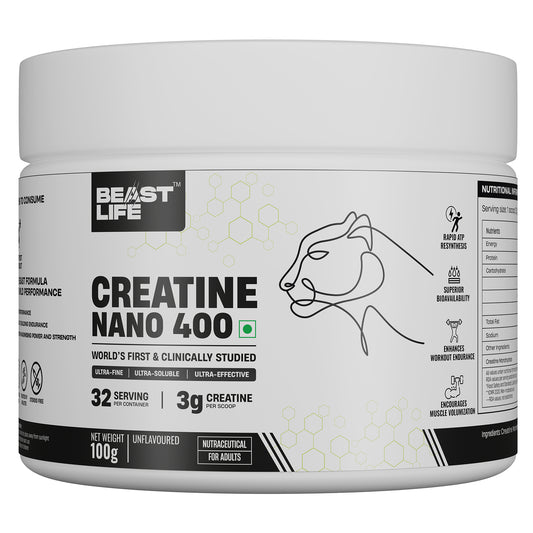
9 Persistent Myths About Micronized Creatine Monohydrate That Are Costing You Results
Creatine monohydrate is the most researched performance supplement in sports nutrition. Micronized creatine monohydrate is its refined version. Neither form is poorly understood by scientists. Both are extremely well understood.
And yet, the volume of misinformation circulating about this compound is remarkable. In gym WhatsApp groups, on supplement store shelves, and across fitness reels, the same myths repeat. Some of them prevent people from trying creatine at all. Others lead to incorrect dosing. A few push people toward more expensive, less studied alternatives.
This piece addresses nine of the most persistent myths about micronized creatine monohydrate, using what the research actually says.
Myth 1 - Micronized Creatine Monohydrate Absorbs Faster Than Standard Monohydrate
The reality: The micronization process reduces particle size for better dispersibility in water. Once the compound reaches your intestinal tract, absorption dynamics are governed by transporter proteins (primarily the creatine transporter SLC6A8), not particle size. Muscle creatine saturation timelines are equivalent between standard and micronized monohydrate when equal doses are consumed.
If you see a product claiming "faster absorption" as the key benefit of micronization, the claim is unsupported by pharmacokinetic data.
Myth 2 - You Must Take Micronized Creatine Monohydrate With Juice or Sugar
The reality: The insulin-potentiation theory holds that consuming creatine with carbohydrates raises insulin, which may support creatine uptake. While insulin does play a role in creatine transport, the practical difference in muscle saturation between taking creatine with juice versus water is minimal in most studied populations.
For most users, taking 3 to 5g of micronized creatine monohydrate with water daily produces full muscle saturation. The sugar requirement is not evidence-based for standard maintenance dosing.
Myth 3 - Creatine Needs to Be Cycled to Stay Effective
The reality: Creatine does not cause receptor downregulation. It does not lose effectiveness with continuous use. The body does not "adapt" to creatine supplementation in a way that reduces its impact over time.
The cycling recommendation appears to have originated from early supplement marketing that drew parallels to stimulant supplements. It has no scientific basis for creatine monohydrate specifically.
What Actually Happens When You Stop Taking Creatine
Muscle creatine levels return to baseline within 4 to 6 weeks of cessation. The performance advantages associated with elevated phosphocreatine stores fade accordingly. There is no benefit to stopping unless you choose to for personal reasons.
Myth 4 - Micronized Creatine Monohydrate Causes Kidney Damage
The reality: Creatine metabolism produces creatinine as a byproduct, which is filtered by the kidneys and excreted in urine. Creatinine is also a standard biomarker in kidney function blood tests. In individuals with healthy kidneys, elevated creatinine from creatine supplementation does not reflect impaired kidney function; it reflects normal supplementation.
Multiple long-term studies and systematic reviews covering years of supplementation in healthy adults have not found evidence of kidney damage from creatine at standard doses. This myth likely persists because of the creatinine-creatine name similarity and because the compound was poorly understood in early supplement culture.
Individuals with pre-existing kidney conditions should consult their doctor before supplementing.
Myth 5 - You Need to Load Micronized Creatine Monohydrate for It to Work
The reality: Loading (20g per day in divided doses for 5 to 7 days) does accelerate the timeline to full muscle saturation. It is not required for the supplement to eventually work. Daily maintenance dosing of 3 to 5g reaches the same saturation level; it simply takes 3 to 4 weeks instead of 5 to 7 days.
If you want faster initial saturation and can tolerate the higher dose without gastrointestinal discomfort, loading is a valid choice. If you prefer a simpler approach, daily maintenance from day one delivers the same endpoint.
Myth 6 - Micronized Creatine Monohydrate Causes Muscle Cramps
The reality: This myth is so pervasive that it deserves clear treatment. Controlled studies on creatine supplementation, including trials in hot and humid conditions, have not found increased rates of muscle cramping compared to placebo groups. Some studies have actually found the opposite, a possible protective effect in endurance athletes.
The cramping concern may have emerged from early observations of dehydration in athletes who were not drinking enough fluid during intense training periods. Creatine does increase intramuscular water retention, which is a reason to ensure adequate overall hydration, not a cause of cramps in itself.
Myth 7 - More Creatine Per Day Means Faster or Better Results
The reality: Muscle creatine transporter capacity has an upper limit. Once stores are saturated, additional creatine beyond the daily maintenance requirement is not stored. It is excreted.
Taking 10g per day instead of 5g does not double the benefit. It doubles the cost and increases the likelihood of gastrointestinal discomfort. Standard dosing at 3 to 5g per day is the evidence-supported range for maintenance.
Myth 8 - Micronized Creatine Monohydrate Makes You Fat or Puffy
The reality: Creatine supplementation does cause an increase in intramuscular water content. This is not subcutaneous water retention (the kind that causes a puffy appearance under the skin). Intramuscular water is held within muscle cells and contributes to the muscle cell volumisation that is associated with an anabolic environment.
Body weight may increase by 0.5 to 1.5kg in the first 1 to 2 weeks of supplementation, particularly with a loading protocol. This is water weight within muscle tissue, not fat gain.
If you are also in a caloric surplus and gaining actual fat, that is diet-driven, not creatine-driven.
Myth 9 - You Do Not Need Creatine if You Already Eat Meat
The reality: Average dietary creatine intake from meat consumption is approximately 1 to 2g per day. Muscle creatine stores can be raised meaningfully above dietary-creatine-fed baseline with an additional 3 to 5g per day of supplementation. Even meat-eaters start below the saturation ceiling that supplementation can reach.
The benefit for meat-eaters may be smaller than for vegetarians (who start from a lower baseline), but it is not zero.
Pairing micronized creatine monohydrate with a complete protein source post-training supports both performance and recovery. Whey protein isolate 1kg options work particularly well in this combination.
FAQs: Micronized Creatine Monohydrate
Q1: Is micronized creatine monohydrate better for mixing?
Yes. The reduced particle size improves dispersibility and reduces undissolved sediment, making it more practical for mixing into multi-ingredient shakes.
Q2: Does micronized creatine monohydrate work for women, too?
Yes. The performance and muscle saturation research for creatine applies to both sexes, though most large trials have been conducted in male populations. Women benefit from the same mechanisms.
Q3: Can I mix micronized creatine monohydrate directly into my protein shake?
Yes. It dissolves more cleanly than standard monohydrate in protein shakes and adds no significant taste when unflavoured.
Q4: Does micronized creatine monohydrate expire?
Yes. Typically, 2 to 3 years from manufacture. Heat and moisture accelerate degradation into creatinine (the inactive byproduct), so store in a cool, dry location.
Q5: Is there a best time of day to take micronized creatine monohydrate?
Consistency matters more than timing. Post-workout is a practical default. Rest day dosing can be taken at any convenient time.
Q6: Does micronized creatine monohydrate need refrigeration?
No. Store at room temperature in a sealed container away from humidity. Refrigeration is unnecessary and can introduce condensation into the powder.
 🎁 1 Lucky Winner Gets an iPhone Duo 📱


 Lowest Price
  Free
Free