
-
Anabolic Mass Gainer with Ultrasorb Tech | No Maltodextrin | Cookies & Cream | 1 kg
Regular price ₹1,099Sale price ₹1,099 Regular priceUnit price per₹1,77838% OFF38% OFFSale -
Anabolic Mass Gainer with Ultrasorb Tech | No Maltodextrin | Cookies & Cream | 2.5 kg
Regular price ₹2,199Sale price ₹2,199 Regular priceUnit price per₹3,91443% OFF43% OFFSale -
 Belgian Chocolate | 2.5kg
Anabolic Mass Gainer with Ultrasorb Tech | No Maltodextrin | Belgian Chocolate | 2.5 kg
Regular price ₹2,199Sale price ₹2,199 Regular priceUnit price per₹3,91443% OFF43% OFFSale -
 Strawberry Banana | 2.5kg
Anabolic Mass Gainer with Ultrasorb Tech | No Maltodextrin | Strawberry Banana | 2.5 kg
Regular price ₹2,199Sale price ₹2,199 Regular priceUnit price per₹3,91443% OFF43% OFFSale -
Anabolic Mass Gainer with Ultrasorb Tech | No Maltodextrin
Regular price ₹1,099Sale price ₹1,099 Regular priceUnit price per₹1,77943% OFF38% OFFSale -
 Belgian Chocolate | 1kg
Anabolic Mass Gainer with Ultrasorb Tech | No Maltodextrin | Belgian Chocolate | 1 kg
Regular price ₹1,099Sale price ₹1,099 Regular priceUnit price per₹1,77938% OFF38% OFFSale -
 Strawberry Banana | 1kg
Anabolic Mass Gainer with Ultrasorb Tech | No Maltodextrin | Strawberry Banana | 1 kg
Regular price ₹1,099Sale price ₹1,099 Regular priceUnit price per₹1,77938% OFF38% OFFSale -
Anabolic Mass Gainer with Ultrasorb Tech | No Maltodextrin | Malai Kulfi | 1 kg
Regular price ₹1,099Sale price ₹1,099 Regular priceUnit price per₹1,77938% OFF38% OFFSale -
 Belgian Chocolate | 5kg
Anabolic Mass Gainer with Ultrasorb Tech | No Maltodextrin | Belgian Chocolate | 5 kg
Regular price ₹3,799Sale price ₹3,799 Regular priceUnit price per₹7,56349% OFF49% OFFSale -
 Strawberry Banana | 5 kg
Anabolic Mass Gainer with Ultrasorb Tech | No Maltodextrin | Strawberry Banana | 5 kg
Regular price ₹3,799Sale price ₹3,799 Regular priceUnit price per₹7,56249% OFF49% OFFSale -
Anabolic Mass Gainer with Ultrasorb Tech | No Maltodextrin | Malai Kulfi | 5 kg
Regular price ₹3,799Sale price ₹3,799 Regular priceUnit price per₹7,56249% OFF49% OFFSale -
The DOMINANCE DUO | Gainer 2.5kg + Creatine 249 g
Regular price ₹2,898Sale price ₹2,898 Regular priceUnit price per₹5,89850% OFF50% OFFSale -
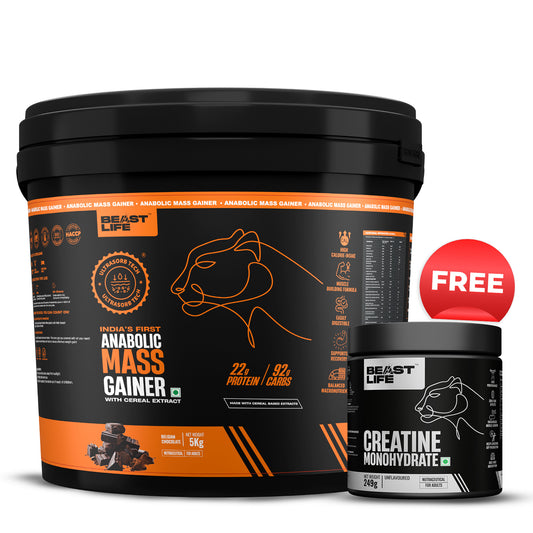 Belgian Chocolate | 5kg
Anabolic Mass Gainer with Ultrasorb Tech | No Maltodextrin | Belgian Chocolate | 5 kg with Free Creatine
Regular price ₹4,598Sale price ₹4,598 Regular priceUnit price per₹9,14849% OFF49% OFFSale -
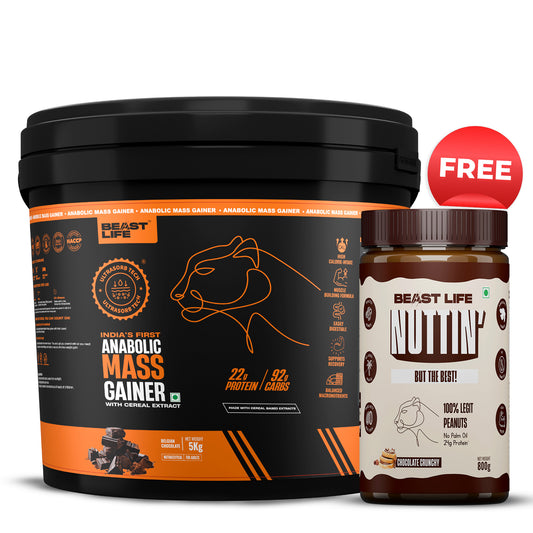 Belgian Chocolate | 5kg
Anabolic Mass Gainer with Ultrasorb Tech | No Maltodextrin | Belgian Chocolate | 5 kg with Free Peanut Butter
- Ultrasorb Tech
- No Maltodextrin
Regular price ₹4,348Sale price ₹4,348 Regular priceUnit price per₹9,14852% OFF52% OFFSale -
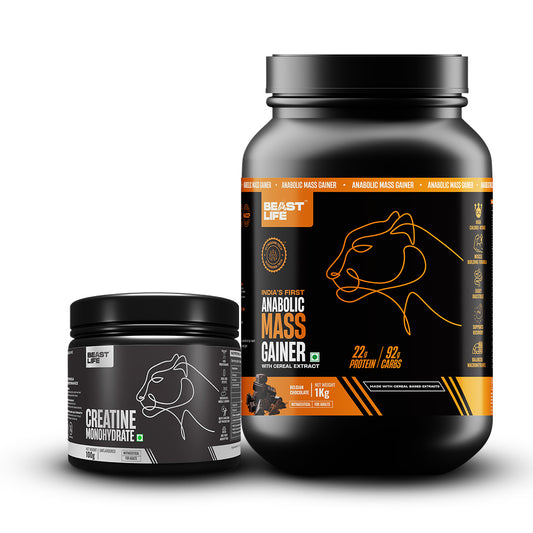
THE BEAST BUILDER KIT | Gainer 1kg + Creatine 100 g
Regular price ₹1,548Sale price ₹1,548 Regular priceUnit price per₹2,74843% OFF43% OFFSale -
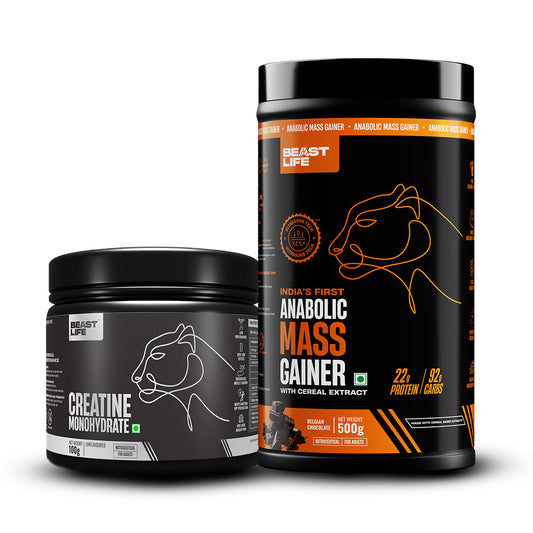
THE GAIN TRAIN EXPRESS | Gainer 500g + Creatine 100 g
Regular price ₹998Sale price ₹998 Regular priceUnit price per₹1,84845% OFF45% OFFSale -
 Nano + Mass Gainer
Combo pack | Creatine Nano 400 | Unflavoured | 100 g + Anabolic Mass Gainer | Belgian Chocolate | 1 kg
Regular price ₹1,898Sale price ₹1,898 Regular priceUnit price per₹2,67829% OFF29% OFFSale -
 Belgian Chocolate | 500g
Anabolic Mass Gainer with Ultrasorb Tech | No Maltodextrin | Belgian Chocolate | 500 g
Regular price ₹549Sale price ₹549 Regular priceUnit price per₹97843% OFF43% OFFSale -
 Strawberry Banana 500g
Anabolic Mass Gainer with Ultrasorb Tech | No Maltodextrin | Strawberry Banana | 500 g
Regular price ₹549Sale price ₹549 Regular priceUnit price per₹97843% OFF43% OFFSale -
 Nano + Mass Gainer
Combo pack | Creatine Nano 400 | Shikanji | 305 g + Anabolic Mass Gainer | Belgian Chocolate | 2.5 kg
Regular price ₹3,798Sale price ₹3,798 Regular priceUnit price per₹5,91335% OFF35% OFFSold out -
 Nano + Mass Gainer
Combo pack | Creatine Nano 400 | Unflavoured | 250 g + Anabolic Mass Gainer | Belgian Chocolate | 2.5 kg
Regular price ₹3,798Sale price ₹3,798 Regular priceUnit price per₹5,91335% OFF35% OFFSold out -
 Malai Kulfi | 2.5kg
Anabolic Mass Gainer with Ultrasorb Tech | No Maltodextrin | Malai Kulfi | 2.5 kg
Regular price ₹2,199Sale price ₹2,199 Regular priceUnit price per₹3,49937% OFF37% OFFSale -
 Sold outNano + Mass Gainer
Combo pack | Creatine Nano 400 | Shikanji | 115 g + Anabolic Mass Gainer | Belgian Chocolate | 1 kg
Regular price ₹1,898Sale price ₹1,898 Regular priceUnit price per₹2,67829% OFF29% OFFSold out




What Actually Is a Mass Gainer? Everything You Need to Know Before Buying
If you have spent time researching fitness supplements, you have seen mass gainer listed alongside whey protein, creatine, and pre-workout as a staple of a muscle-building supplement stack. But while most people have a rough idea of what whey protein does, mass gainer generates considerably more confusion. Is it just protein powder with extra carbohydrates? Is it only for underweight people? Will it cause fat gain? Should beginners use it at all? These are real questions that deserve direct answers before any purchase decision. This guide covers what mass gainer is, how it works physiologically, who genuinely benefits from it, and what to look for when choosing a product worth spending money on.
What Is a Mass Gainer?
A mass gainer is a calorie-dense supplement powder formulated to help individuals increase total daily calories and protein intake. Unlike whey protein, which is primarily a protein source contributing modest calories per serving, a mass gainer provides a combination of protein, carbohydrates, and fat in a single serving that delivers anywhere from 300 to 1,200 calories.
The purpose is straightforward: for individuals who burn more calories than they can consistently eat through whole food, or who need a practical tool for hitting a daily caloric surplus, a mass gainer makes reaching that target significantly easier. Mass gainers are not protein powders. They are not meal replacements. They are calorie-dense nutrition supplements designed to complement a diet, not substitute for one.
Why Do People Use Mass Gainers?
People use mass gainers for a range of related but distinct reasons:
- To increase total daily calorie intake when food volume alone is insufficient to create and sustain a caloric surplus
- To support muscle development by providing both protein for muscle protein synthesis and carbohydrates for glycogen replenishment and training energy
- For convenience, preparing multiple high-calorie meals throughout a busy day is not consistently practical
- As a structured component of a bulking phase, where macronutrient targets are defined, a mass gainer helps meet them consistently
- To address the genuine difficulty of gaining weight in individuals with fast metabolisms, high activity levels outside the gym, or low appetite
Who Actually Needs a Mass Gainer?
Mass gainers are not appropriate for everyone who goes to the gym. They are most useful for:
Hardgainers and ectomorphs: Individuals who eat substantial quantities of food but consistently fail to create a surplus large enough for weight gain due to metabolic rate or appetite limitations. For this group, a mass gainer can produce measurable change where diet alone has failed.
Beginners who are significantly underweight: When an underweight beginner starts a gym programme, the combination of training stimulus and caloric surplus from a mass gainer creates conditions for rapid early lean mass development.
Athletes in a structured bulking phase: Intermediate and advanced athletes deliberately in a caloric surplus phase to maximise muscle development benefit from a gainer's calorie density and macronutrient structure.
Individuals with physically demanding jobs or lifestyles: A person burning 3,500 to 4,000 calories daily through combined work and training activity has a surplus requirement that is practically impossible to meet through food alone.
For athletes looking for pure protein support rather than a full-calorie supplement, the whey protein for weight gain collection provides a high-protein, lower-calorie option better suited to individuals who already meet their calorie targets through food.
What Is Inside a Mass Gainer?
Protein Sources
Quality mass gainers use whey protein concentrate or isolate as the primary protein source. Whey provides all nine essential amino acids, high leucine content for muscle protein synthesis, and fast absorption suited to post-workout use. Some products use a blend of whey and casein to provide both fast and sustained amino acid delivery across the hours following consumption.
Carbohydrate Sources
Carbohydrates make up the largest portion of most mass gainer formulas by weight. Quality sources include oat flour and oat powder for complex slow-release energy, brown rice powder for digestible clean carbohydrate, sweet potato powder for a moderate glycaemic index carbohydrate, and maltodextrin in limited quantities for fast post-workout glycogen replenishment. Products relying primarily on added sugar for carbohydrate content are lower-quality formulations that are more likely to promote fat gain.
Fats
Mass gainers typically include 5 to 15g of fat per serving from natural sources, including sunflower oil powder, medium-chain triglycerides, or naturally occurring fats from oat and milk fractions.
What to Look for on a Mass Gainer Label
Before any purchase, verify these six criteria:
- Protein per serving of at least 25g from whey protein fractions
- Complex carbohydrates listed first among carbohydrate sources
- Added sugar below 10g per serving
- Full ingredient list with no proprietary blends hiding individual quantities
- FSSAI license number present on packaging
- Amino acid profile disclosed per serving, including leucine content
The best whey protein for muscle gain collection is a useful reference for understanding what quality protein sourcing looks like in supplement products, which applies equally to evaluating the protein component in any mass gainer.
What a Mass Gainer Will Not Do
Setting accurate expectations is essential before any purchase:
- A mass gainer will not build muscle without consistent resistance training
- It will not produce results without a structured nutrition plan supporting it
- It is not a substitute for whole food nutrition and the micronutrients that whole food provides
- It does not guarantee any specific body composition outcome
- Results vary significantly based on individual metabolism, training quality, recovery, and overall diet
The beast whey protein range provides a clean protein supplement for athletes who want a fast-absorbing recovery option post-workout alongside a mass gainer's calorie and carbohydrate provision across the day.
Frequently Asked Questions
Q1: Is a mass gainer the same as a protein powder?
No. Whey protein is primarily a protein source with a low calorie contribution per serving. A mass gainer is a calorie-dense supplement combining protein, carbohydrates, and fat. They serve different roles in a nutrition plan.
Q2: Will mass gainer make me fat?
If total daily calorie intake consistently exceeds expenditure beyond the intended surplus, fat accumulation will occur regardless of the food source. Used within a planned caloric surplus alongside training, mass gainers support lean mass development rather than fat gain.
Q3: Is mass gainer suitable for beginners?
Yes, for beginners who are underweight or genuinely struggling to create a caloric surplus through food alone. Beginners who already meet their calorie needs through diet do not necessarily need a mass gainer.
Q4: Can I use mass gainer and whey protein at the same time?
Yes. This is a common and effective combination. Mass gainer is used for calorie and carbohydrate support; whey protein is used around training for fast-absorbing recovery protein. They serve complementary purposes.
Q5: When is the best time to take a mass gainer?
Post-workout and between meals are the two most practical windows. Post-workout timing supports muscle recovery and glycogen replenishment simultaneously.
Q6: How long should I use a mass gainer?
Mass gainer use is most appropriate during a defined bulking or weight gain phase, typically eight to sixteen weeks. Reassess your supplementation approach at the end of each training phase.


