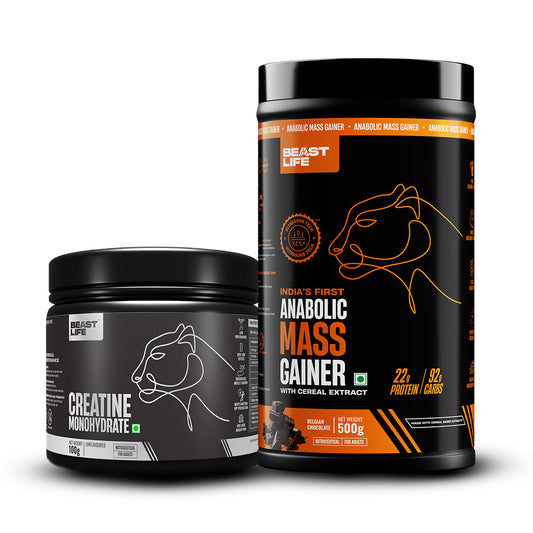
Free Creatine ends in:
00
Days
00
hrs
00
Min
00
Sec

Collection: Best Muscle Mass Gainer

Built for Growth: Choosing the Best Muscle Mass Gainer Based on Science

Building muscle is not simply a matter of eating more. The type of calories you consume, the ratio of protein to carbohydrates in your surplus, and the specific nutritional profile of your supplements directly determine whether extra calorie intake translates into muscle tissue or body fat. The best muscle mass gainer is one designed around the science of muscle hypertrophy, not around maximising calories per serving or minimising cost per rupee. This guide breaks down what the research says about nutritional requirements for muscle development, which ingredients in a mass gainer serve those requirements, and how to separate a product genuinely built for muscle gain from one that simply looks the part.


The Calorie-Protein Balance That Drives Muscle Growth


Why Calories Alone Do Not Build Muscle

A caloric surplus is necessary for muscle growth, but not sufficient by itself. Research from the ISSN confirms that the rate and quality of muscle development depend heavily on protein intake relative to total calorie consumption. A gainer delivering 1,000 calories per serving but only 20g of protein provides a large energy surplus with insufficient amino acid availability to fully support muscle protein synthesis.

For the best muscle mass gainer to work as intended, it must deliver enough protein per serving to satisfy the muscle-building stimulus created by resistance training, not just enough calories to prevent catabolism.


The Ideal Macronutrient Profile for a Muscle-Focused Gainer

Research supports the following target profile:

  • Protein per serving: 30 to 45g from quality whey protein fractions
  • Carbohydrates per serving: 60 to 90g from complex sources for sustained energy
  • Fat per serving: 5 to 10g, preferably from natural food sources
  • Calorie density: 450 to 700 calories per serving
  • Leucine per serving: At least 2.5 to 3g to effectively trigger muscle protein synthesis


Ingredient Spotlight: What Is Inside the Best Muscle Mass Gainer


Protein Source Quality

The protein component of a muscle mass gainer is its most important ingredient. Whey protein concentrate or isolate should appear first or second in the ingredient panel. Whey protein provides all nine essential amino acids, the highest leucine content of any commonly used protein source, fast digestion suited to post-workout use, and a biological value above 100.

Soy protein and pea protein appear in some products as lower-cost alternatives. While complete proteins in their own right, they provide lower leucine content and slower absorption than whey. Their presence as a primary protein source is a quality downgrade.

Collagen protein is inappropriate as a primary muscle-building protein source. It is an incomplete protein missing tryptophan, one of the nine essential amino acids. Products using collagen to inflate protein readings are engaging in a form of amino acid spiking.


Carbohydrate Source Quality

Complex carbohydrates are the engine of a muscle mass gainer. They provide sustained training energy, glycogen replenishment after resistance training, and a protein-sparing effect that allows dietary protein to be used for muscle repair rather than energy production.


Quality carbohydrate sources:

  • Oat flour or oat powder: slow-digesting, provides sustained energy across training sessions
  • Sweet potato powder: complex carbohydrate with a moderate glycaemic index
  • Brown rice powder: mild flavour, easily digestible, steady energy release
  • Waxy maize starch: fast-digesting post-workout carbohydrate for glycogen replenishment


Carbohydrate sources to scrutinise:

  • Maltodextrin as the sole carbohydrate: high glycaemic, not ideal as the only source
  • Sucrose or dextrose as the primary carbohydrate indicates a lower-quality formulation relying on cheap sugar for calorie density


How to Use the Best Muscle Mass Gainer Effectively


Timing Matters Here

Post-workout: The most effective timing for a muscle mass gainer. Within one to two hours of resistance training, consuming a gainer delivers both the protein needed for muscle repair and carbohydrates for glycogen replenishment simultaneously.


Between meals: For hard gainers who cannot sustain their caloric surplus through food alone, a gainer serving between meals adds meaningful calories without requiring a large post-workout appetite.


Not as a meal replacement: Whole food meals provide micronutrients, dietary fibre, and food-based compounds that supplements cannot replicate. A gainer adds to your diet; it does not replace any part of it.


For athletes pairing a muscle mass gainer with a dedicated whey protein supplement, the whey protein for weight gain collection provides targeted protein options suited to complement a gainer's calorie and carbohydrate structure.


Quality Checklist for Any Muscle Mass Gainer

Before purchasing, verify each of these:

  • Whey protein fractions are listed as the primary protein source, not a generic "protein blend"
  • Complex carbohydrates listed first among carbohydrate sources
  • Added sugar below 10g per serving
  • Full ingredient list without proprietary blends hiding individual quantities
  • FSSAI license number present on packaging
  • Amino acid profile disclosed per serving, including BCAA and leucine content
  • Third-party testing certification, where available

The beast whey protein range provides a useful complementary option for athletes who want a clean post-workout protein serving alongside their muscle mass gainer, particularly during high-volume training phases. For those comparing protein quality standards between standalone products and mass gainers, the best whey protein for muscle gain collection provides the benchmark.


Frequently Asked Questions


Q1: How much protein should the best muscle mass gainer have per serving?

Look for 30 to 45g per serving from whey protein fractions. Products below 25g per serving are more accurately calorie supplements with supplementary protein than genuine muscle-building tools.


Q2: Should I use a muscle mass gainer on rest days?

Yes. Muscle repair continues on non-training days. Meeting daily calorie and protein targets on rest days supports consistent recovery and gains over time.


Q3: Can I take a muscle mass gainer and a whey protein supplement on the same day?

Yes. Many athletes use mass gainer for calorie and carbohydrate support at one point in the day and whey protein post-workout for faster amino acid delivery. The two products serve complementary purposes.


Q4: Is maltodextrin in mass gainers a concern?

As a sole carbohydrate source, maltodextrin is a lower-quality choice. As a partial carbohydrate alongside complex sources, it is less concerning. Evaluate the full carbohydrate profile rather than reacting to one ingredient in isolation.


Q5: How do I know if a muscle mass gainer is working?

Gradual weekly weight gain of 0.5 to 1kg, improved training strength across successive weeks, and reduced muscle soreness between sessions are positive indicators. Results depend heavily on training consistency and total daily nutrition.


Q6: Can I build muscle with a mass gainer without resistance training?

Without a training stimulus to signal muscle growth, additional calories are stored predominantly as fat. A mass gainer provides the nutritional substrate for muscle development; progressive resistance training provides the signal that directs those nutrients toward muscle tissue.