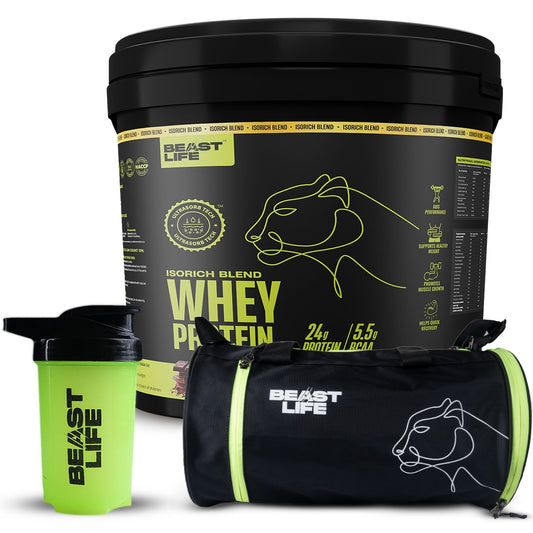
Best Whey Protein Isolate in India: A Buyer's Guide Built for the Indian Market
The best whey protein isolate in India is not necessarily the most expensive one, the most heavily marketed one, or the one with the most flavour options. It is the one that delivers verified protein content at a price point that makes daily use sustainable, from a brand that does not cut corners on raw material quality. This guide is written specifically for the Indian buyer, covering what the local market looks like, what questions to ask before purchasing, and how to evaluate products without needing a chemistry degree.
Why the Indian Supplement Market Needs a Different Conversation
India is now one of the fastest-growing sports nutrition markets in the world, and with that growth has come a flood of products at every price point. The challenge for Indian consumers is that regulatory oversight of supplements is limited compared to the US or Europe, and third-party testing is not yet standard practice across domestic brands. This creates a market where a product can be labelled as whey protein isolate while delivering concentrate-level protein at isolate-level prices.
Understanding this context is not about distrust for its own sake. It is about knowing what to verify before spending 3,000 to 5,000 rupees on a tub.
What a Good Whey Protein Isolate Must Deliver in India
Protein per serving: the non-negotiable
A genuine isolate must deliver at least 25 g of protein in a 28 to 33 g serving. Run the calculation yourself: protein grams divided by serving size in grams, multiplied by 100. The result should be 85 percent or higher. If it falls below 80 percent, the product is either a blend or a concentrate being sold as an isolate.
Fat and carbohydrate content
A true isolate should have no more than 1 to 2 g of fat and 2 to 3 g of carbohydrates per serving, often less. Products with 5 g or more of carbohydrates per serving are almost certainly concentrate-dominant blends.
Lactose content
Most Indian buyers do not check this, but it is the clearest indicator of filtration quality. A properly processed isolate should have lactose content under 1 g per serving. Brands that do not disclose lactose content on the label are worth questioning.
Raw material sourcing
The two most trusted international sources for whey in the Indian market are Glanbia (Ireland), which supplies Optipep and Provon isolates, and Hilmar (USA). Domestic brands that source from these suppliers and disclose it on their packaging or website are generally more trustworthy than brands using unspecified domestic whey sources.
The Filtration Methods Behind Indian Whey Isolates
Cross-flow microfiltration
CFM uses a cold, membrane-based filtration process that physically separates protein from fat and lactose without chemical treatment. This method preserves the natural protein fractions in whey, including beta-lactoglobulin, alpha-lactalbumin, immunoglobulins, and lactoferrin. These fractions have documented benefits for immune function and recovery beyond their amino acid contribution. CFM is the preferred method for premium isolates.
Ion exchange
Ion exchange uses a chemical process involving hydrochloric acid and sodium hydroxide to isolate the protein. The result is a very high protein percentage, often 95 percent or more, but the process selectively enriches beta-lactoglobulin while destroying most other bioactive fractions. The product is technically high in protein but lacks the broader nutritional complexity of CFM-processed isolate. Ion exchange isolate is not inferior for muscle building, but it is not the best version of what whey can offer.
What most Indian brands use
The majority of Indian brands, even premium-positioned ones, do not clearly disclose their filtration method. If a brand cannot tell you whether their isolate is CFM or ion exchange processed, that is information worth noting when making your decision.
How Indian Buyers Get Misled: Common Label Tricks
The blend labelled as isolate
This is the most widespread issue in the Indian market. A product's front-of-pack branding reads "Whey Isolate" in large text. Turning to the ingredient list, you find: whey protein concentrate, whey protein isolate, listed in that order. Because ingredients are listed by weight, the first ingredient is present in the highest quantity. This product is primarily a concentrate with a smaller amount of isolate added, yet it is marketed as an isolate product.
Always read the ingredient list, not the front label.
Inflated serving sizes
Some brands use a 40 g serving size to deliver 28 g of protein, which sounds impressive until you realise that 28 divided by 40 is only 70 percent protein by weight. The same 28 g of protein in a proper isolate would come in a 30 to 31 g serving.
Proprietary blends
When a product lists a "proprietary protein blend" without specifying how much of each protein type is included, you have no way of knowing what you are actually paying for. Avoid these products entirely when buying a premium isolate.
India-Specific Considerations When Buying Whey Isolate
Storage and climate
India's heat and humidity accelerate protein degradation. Always buy from sellers who store products in temperature-controlled environments, and check the manufacturing date, not just the expiry date, before purchasing. A tub manufactured 18 months ago with a 24-month shelf life has been sitting somewhere for a long time. Fresher is better.
Flavour and mixability in Indian conditions
Most international isolate products were formulated for Western taste preferences. Flavours like plain vanilla and chocolate tend to translate well. Some consumers find internationally formulated products either too sweet or too artificial when mixed in Indian water. Domestic brands sometimes have an edge here in palatability.
Online vs offline purchasing
Counterfeit supplements are more common in India's offline retail market than in e-commerce channels from established sellers. If buying offline, purchase directly from authorised brand outlets or well-established supplement stores rather than general pharmacies or gym reception desks.
Whey Isolate for Specific Indian Goals
For the Indian gym-goer on a cut
India's fitness culture has shifted significantly toward physique-conscious training, particularly in metros. If you are running a calorie deficit while training four to five days a week, an isolate's low fat and carbohydrate content means you can hit a 25 to 28 g protein dose in 110 to 120 calories rather than 130 to 150 calories for a concentrate. Over a 12-week cut with two daily servings, this difference adds up.
For the lactose-intolerant Indian athlete
Lactose intolerance affects a significant portion of the South Asian population. If you experience bloating, cramping, or loose stools after regular dairy or whey concentrate, switching to a properly processed isolate is likely to resolve the issue. The residual lactose in a quality isolate, under 1 g per serving, is below the threshold that triggers symptoms in most lactose-sensitive individuals.
For the vegetarian Indian looking to build muscle
For vegetarian Indians whose daily protein from food peaks at 60 to 70 g even with careful meal planning, an isolate that delivers 25 to 28 g of complete protein in a single serving is one of the most efficient tools available. Paired with a protein-conscious Indian diet, one to two scoops of isolate per day can bridge the gap to the 120 to 150 g daily target needed for serious muscle gain.
If you are also trying to manage total supplement costs while building this routine, starting with something from BeastLife's whey protein under 3,000 rupees collection lets you establish the habit of daily protein supplementation before committing to a higher-priced isolate product.
What to Expect After Switching to Whey Isolate
Most people notice two things within the first two weeks of switching from concentrate to isolate: improved digestion (less bloating and gas, particularly if they had mild lactose sensitivity), and marginally better body composition results when combined with consistent training and calorie management. The second benefit is subtle and should not be overstated. Isolate will not produce dramatically better muscle gain than concentrate for most people. The difference lies in digestive comfort and caloric efficiency.
When to Consider a Mass Gainer Instead
Whey isolate is a low-calorie, high-protein product. It is the right tool if you are already eating enough calories and simply need to increase protein intake. If you are a hard-gainer who struggles to eat enough food in a day, finds it difficult to maintain weight, or is in a deliberate bulk phase, an isolate is not the appropriate product. In that case, pairing your meals with one of the best mass gainers for bulking is a more aligned approach, as it provides the caloric surplus your muscles need to grow alongside a substantial protein dose.
Frequently Asked Questions
Q1: Which whey protein isolate is best in India?
The best isolate in India is the one that delivers 85 to 90 percent protein by weight per serving, uses CFM or membrane filtration processing, sources whey from a certified international supplier, and provides third-party testing documentation. No single brand is universally best because quality varies by batch and the market changes frequently. Use the protein-per-serving percentage calculation as your primary filter and cross-check with independent testing databases before buying.
Q2: Is whey protein isolate available in India at a reasonable price?
Yes, but the definition of reasonable matters. A legitimate isolate costs more to produce than a concentrate. Products priced at 1,000 to 1,500 rupees per kg that claim to be isolates should be verified carefully. In the 2,500 to 4,000 rupees per kg range, there are several credible options from both domestic and international brands operating in India.
Q3: How do I know if a whey protein isolate is genuine in India?
Check the protein percentage per serving using the calculation described in this article. Read the ingredient list and confirm that whey protein isolate is listed first. Look for third-party testing certifications on the brand's website. Purchase from authorised sellers rather than unverified resellers. If the price seems too low for a genuine isolate, it probably is.
Q4: Can whey protein isolate help with fat loss in India?
Isolate supports fat loss indirectly by helping you meet high protein targets within a controlled calorie budget. It is not a fat burner. The mechanism is that higher protein intake during a calorie deficit preserves lean muscle mass, which keeps metabolism from declining as sharply as it would on a low-protein diet. Combined with a calorie deficit and consistent training, isolate is a useful tool in a fat loss phase.
Q5: Is Indian-made whey protein isolate as good as imported brands?
Some Indian-manufactured isolates that source their raw whey from certified international suppliers and use proper filtration methods are comparable in quality to imported products. The key is not where the product is packaged but where the whey is sourced and how it is processed. Domestic brands that are transparent about their raw material sourcing and publish testing data are worth serious consideration.
 🎁 1 Lucky Winner Gets an iPhone Duo 📱


 Lowest Price
  Free
Free