Beginner’s Guide to Creatine: Its Benefits and Who Should Take It

You have seen creatine in almost every serious lifter's gym stack and probably wondered whether it is a steroid, a fad or the real deal. In this guide, we'll explain what is creatine, how it works, and how to take it safely.
Overview
-
Creatine is a natural compound stored mainly in muscle that helps regenerate ATP during short, intense efforts.
-
About 95% of the body's creatine sits in skeletal muscle, according to the International Society of Sports Nutrition.
-
Creatine plus resistance training raised strength by 20%, versus 12% for training alone, in a review of 22 studies.
-
Vegetarians start with lower muscle creatine and respond more strongly to supplementation.
-
The standard daily dose is 3-5 g, and a loading phase is optional.
-
Creatine is a food-derived compound, not a steroid or a hormone.
-
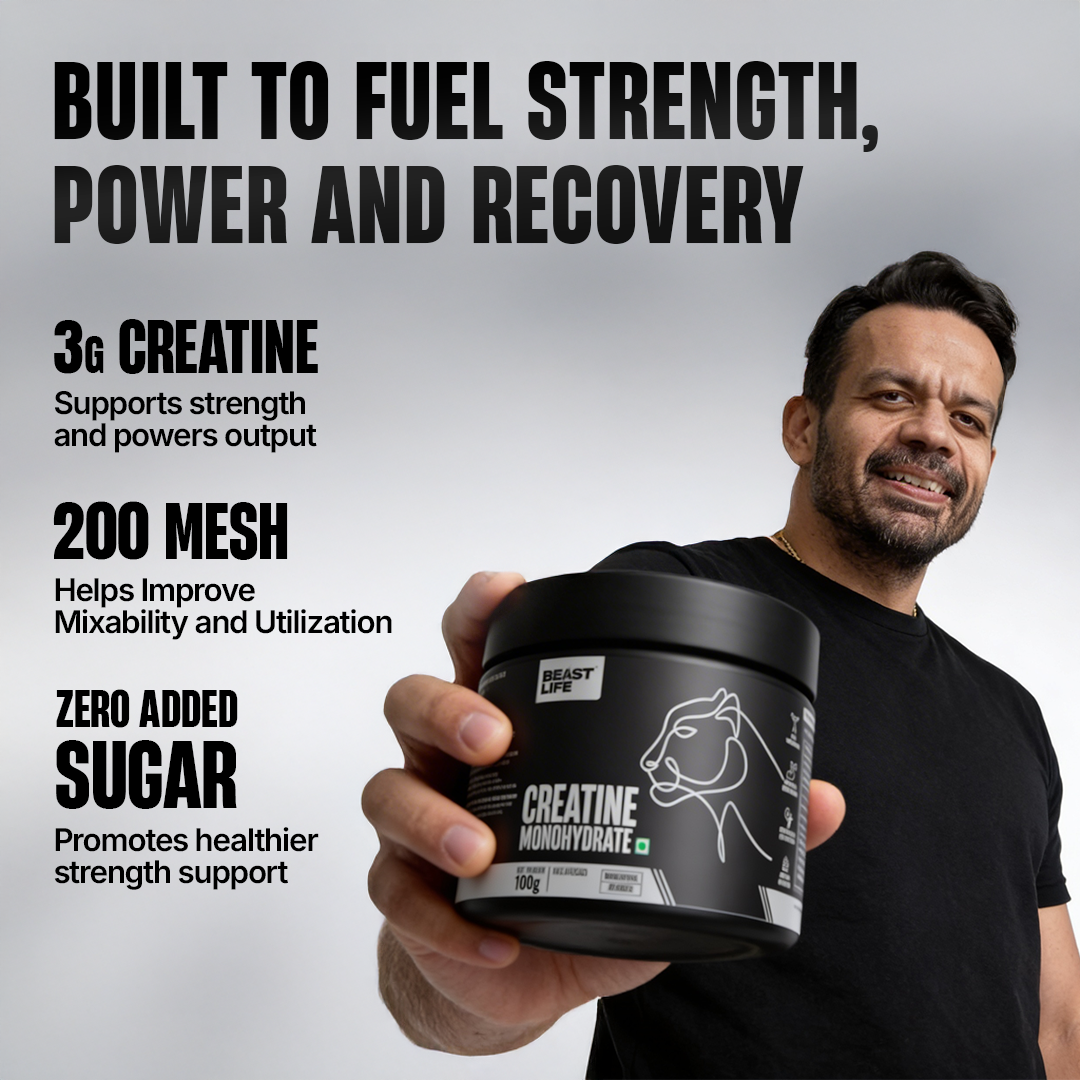
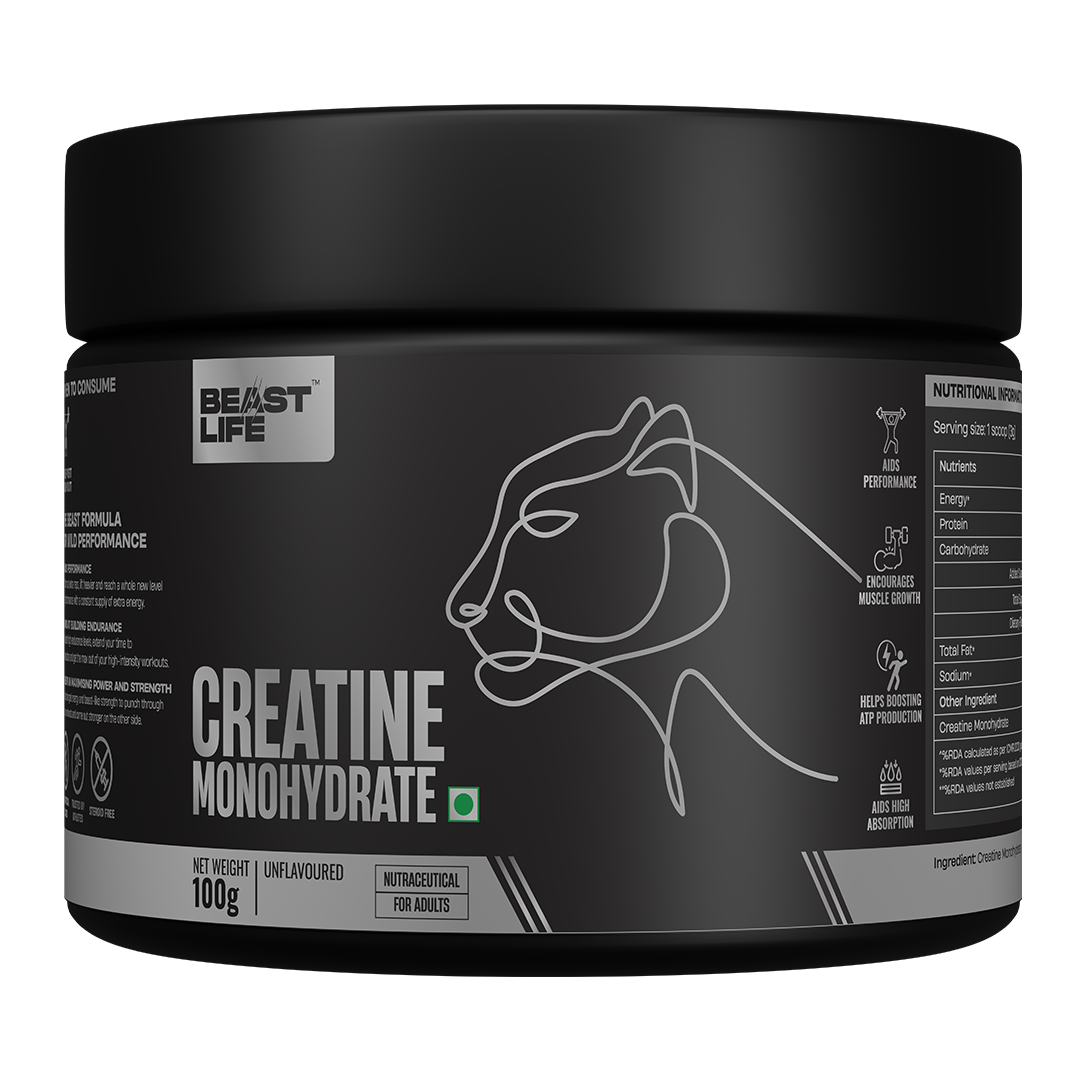
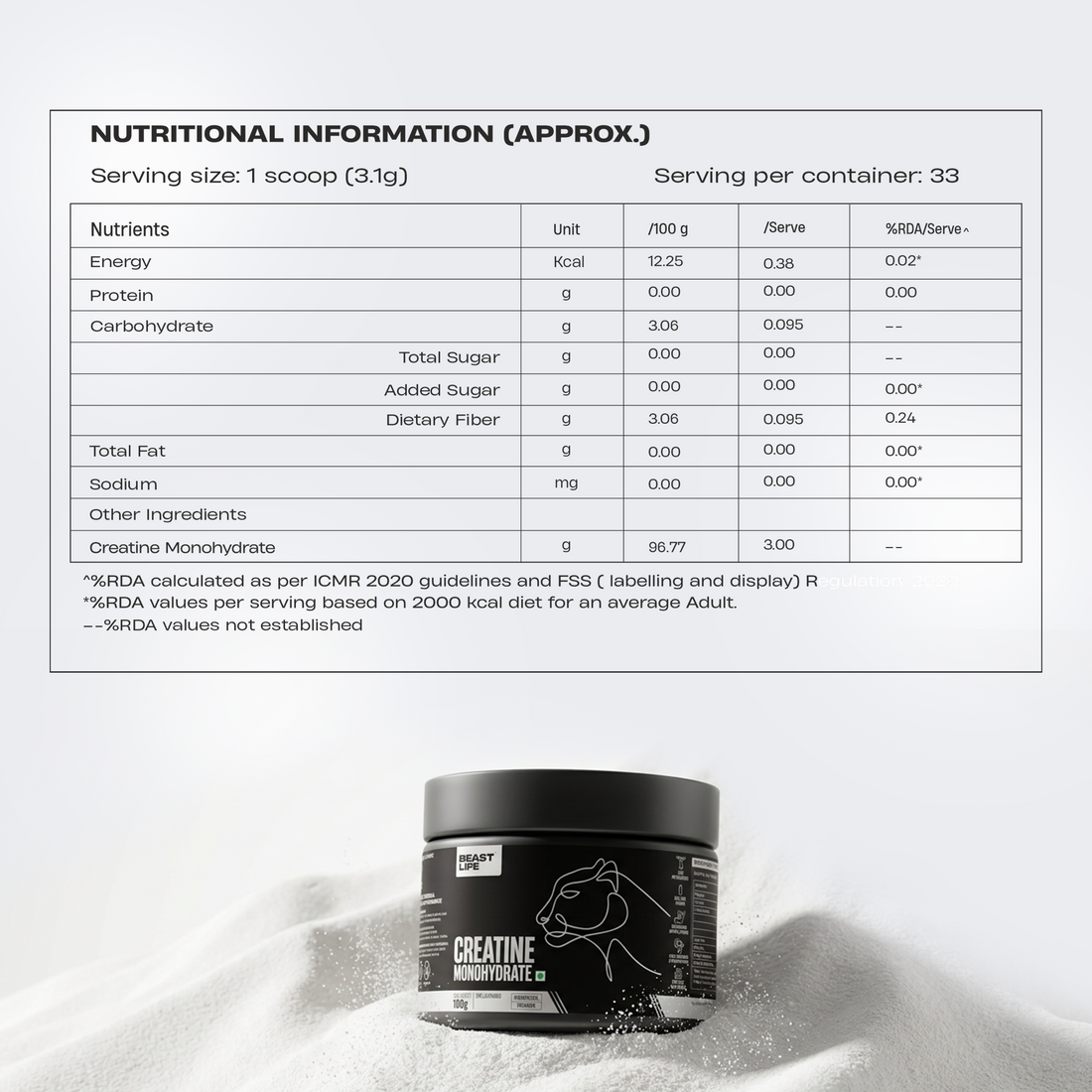
BeastLife Creatine Monohydrate gives 3 g per serving in a 200-mesh, vegan, zero-added-sugar powder.
What Is Creatine?
Creatine is a naturally occurring compound, built from the amino acids glycine, arginine and methionine, that your muscles use to regenerate ATP, the fuel for short, explosive effort. Roughly 95% of your body's creatine is stored in skeletal muscle as phosphocreatine. Source: Kreider et al., Journal of the International Society of Sports Nutrition, 2017. Your body makes around 1 g a day, and an omnivorous diet supplies about another gram from meat and fish. That is why vegetarian gym goers, who get almost none from food, often have lower stores.
Creatine Monohydrate is the supplement form with the deepest research base. BeastLife Creatine Monohydrate supplies 3 g per serving, uses UltraFine HPM™ processing with 200-mesh particles for smooth mixing, and is 100% vegan with zero added sugar.
Why Creatine Matters
Creatine matters because it is one of the few supplements with consistent evidence for strength and lean-mass gains. A review of 22 studies found that strength rose about 20% with creatine plus resistance training versus 12% with training alone, and weightlifting performance rose 26% versus 12%. Source: Rawson & Volek, Journal of Strength and Conditioning Research, 2003. The International Society of Sports Nutrition concludes that creatine monohydrate is the most effective supplement currently available for high-intensity exercise capacity and lean body mass. Source: Kreider et al., 2017.
Creatine also suits vegetarian lifters. Vegetarians in an eight-week trial began with lower muscle creatine (117 vs 130 mmol/kg) and gained more lean tissue after supplementing than meat-eaters. Source: Burke et al., Medicine & Science in Sports & Exercise, 2003. A systematic review further suggests creatine may improve short-term memory in healthy people. Source: Avgerinos et al., Experimental Gerontology, 2018.
How Does Creatine Work?
The ATP Recharge System
Creatine works by topping up phosphocreatine, which donates a phosphate to rebuild ATP within seconds. During a heavy set of squats, ATP runs out in a few seconds, so a larger phosphocreatine reserve means more quality reps before fatigue arrives. Over weeks, those extra reps become more training volume, and more volume drives strength and muscle growth.
Water Inside the Muscle
Creatine also draws water into muscle cells, giving a fuller look. This early scale-weight rise is mostly intracellular water, not fat, so a small jump in the first weeks is expected and harmless.
Is Creatine Safe, and Is It a Steroid?
Creatine is not a steroid; it is a compound found in meat and fish and made by your own liver and kidneys. The International Society of Sports Nutrition reports no compelling evidence that short- or long-term use harms healthy individuals at recommended doses. Source: Kreider et al., 2017. Anyone with kidney disease, anyone on medication, and anyone under 18 should speak to a doctor first.
Your Daily Creatine Routine
A creatine routine is one scoop of 3 g, taken daily at a time you will remember. Loading (20 g a day for 5-7 days) saturates muscles faster, but 3 g a day for 28 days reaches similar levels. Source: Hultman et al., Journal of Applied Physiology, 1996. We suggest one scoop four times daily for 5-7 days if you choose to load, then one scoop daily. Take it on rest days too.
Shop BeastLife Creatine Monohydrate
Start Creatine the Smart Way
Your next step is to pick one product and one habit. Choose a 100 g pack to test taste and tolerance, link your scoop to something fixed like your morning water or post-workout shake, and drink enough fluids through the day. Track your main lifts for eight weeks, because creatine rewards consistency, not perfect timing.
Conclusion
Creatine is not magic and not dangerous; it is a well-researched way to power more reps. Take 3 g daily, stay hydrated, keep your protein and training in order, and give it a few weeks. Fuel the discipline, and let the evidence work for you.