
Is BCAA as a Pre Workout Worth it in 2027?

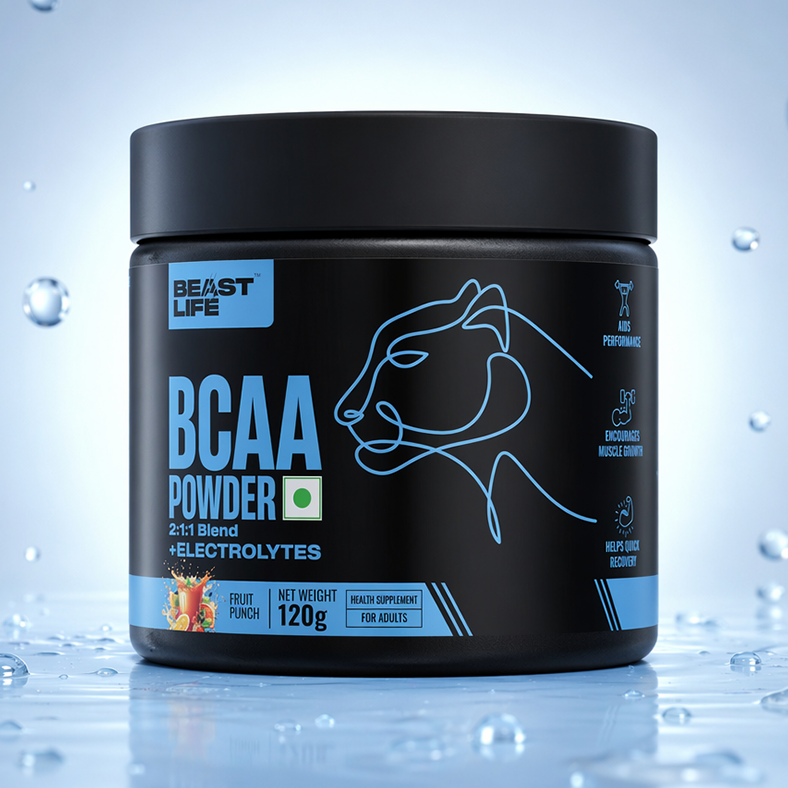
You have probably added BCAAs to your pre-workout routine because everyone at the gym seems to, and you may be wondering if they do anything. BCAAs are marketed as essential, yet the research paints a more nuanced picture. In this guide, we'll explain whether a BCAA pre workout is worth it, how to use it, and what to take instead.
Overview
-
BCAA pre workout means taking leucine, isoleucine and valine, commonly 5-10 g, about 30 minutes before training.
-
BCAAs alone raised muscle protein synthesis by 22%, which is about half the response seen with whey.
-
BCAAs are not stimulants, so they do not provide caffeine-style energy or focus.
-
Lifters eating 1.6 g/kg of protein daily gain little extra from BCAAs.
-
Caffeine at 3-6 mg/kg is the best-supported pre-workout aid, according to the International Society of Sports Nutrition.
-
BeastLife Beast Mode Pre Workout combines 200 mg caffeine, 1,000 mg creatine and 6,000 mg beta-alanine with zero added sugar.
-
One scoop of BeastLife Pro Concentrate Whey gives 5.34 g of BCAAs plus all nine essential amino acids.
What Is a BCAA Pre Workout?
A BCAA pre workout is a dose of branched-chain amino acids, leucine, isoleucine, and valine, taken before training to have amino acids circulating during the session. BCAAs are broken down largely in muscle rather than the liver, so they reach working muscle quickly.
Why the BCAA Debate Matters
The BCAA debate matters because it decides where your money goes: a tub of aminos or more food and a better pre-workout. In a trial of resistance-trained men, 5.6 g of BCAAs lifted muscle protein synthesis by 22% over placebo. Source: Jackman et al., Frontiers in Physiology, 2017. However, that was roughly half the response seen with whey in comparison studies, and a review concluded that BCAAs alone cannot maximise muscle building because the other essential amino acids become limiting. Source: Wolfe, Journal of the International Society of Sports Nutrition, 2017.
This is why BeastLife Pro Concentrate Whey is an efficient alternative. One scoop provides 5.34 g of BCAAs, close to the dose studied, alongside 11.55 g of essential amino acids and 24 g of protein, made through Cross-Flow Microfiltration with Ultrasorb Tech™ for a lighter feel.
The Case For Taking BCAAs Before Training
Less Soreness and Better Recovery
BCAAs can reduce delayed-onset muscle soreness. In a controlled study, BCAAs taken before squats reduced soreness and muscle fatigue in the following days. Source: Shimomura et al., International Journal of Sport Nutrition and Exercise Metabolism, 2010. Less soreness helps you keep training consistently, which is where progress actually compounds.
Useful for Fasted or Low-Protein Days
BCAAs offer a convenient amino acid top-up when you train before breakfast or struggle to reach your protein target. This is relevant for vegetarians, whose dal-and-sabzi diets often fall short; an IMRB survey found 84% of vegetarian diets in India were low in protein. Source: IMRB, 2017.
The Case Against BCAA Pre Workout
If Your Protein Is Sufficient, BCAAs Add Little
BCAAs add little once your daily protein is adequate, because food and whey already contain them. Protein supplementation benefits level off near 1.6 g/kg/day. Source: Morton et al., British Journal of Sports Medicine, 2018. If you are above that line, BCAAs are mostly an expensive flavoured drink.
BCAAs Are Not Pre-Workout Stimulants
BCAAs do not deliver the energy and focus lifters expect from a pre-workout. They contain no caffeine, no nitric oxide boosters and no beta-alanine. If you need drive on a low-energy day, a BCAA scoop will not provide it.
What to Take Instead: Better Pre-Workout Options
A complete pre-workout is a formula that combines stimulants, pump ingredients and buffering agents, and it targets different goals than BCAAs. Caffeine at 3-6 mg/kg body weight, taken about an hour before training, improves exercise performance. Source: International Society of Sports Nutrition, 2021.
BeastLife Beast Mode Pre Workout supplies 200 mg caffeine, plus L-theanine for smoother focus, 6,000 mg beta-alanine, 1,000 mg creatine monohydrate, L-citrulline DL-malate and L-arginine HCl for pumps, all with zero added sugar. Take one scoop in 200 ml water before training days only, and avoid taking it late in the evening.
Choose Your Pre-Workout Drink in Three Questions
A pre-workout decision tree is a fast way to match the supplement to the problem. Ask yourself:
-
Is my problem low energy or focus? Choose a caffeine-based pre-workout like BeastLife Beast Mode Pre Workout.
-
Is my problem low daily protein? Add a whey or pea protein scoop, not BCAAs.
-
Is my problem soreness or fasted training? A BCAA serving is a reasonable trial.
Test, Track, Decide
Your next step is to change one variable at a time. Check your daily protein first, then run a two-week trial of whichever supplement matches your problem. Track soreness, energy and training quality in a notes app. Beginners should start with a smaller pre-workout dose to assess caffeine tolerance, and anyone with a medical condition should consult a doctor first.
Conclusion
A BCAA pre workout is neither a scam nor a necessity. It helps most when protein is low or training is fasted, and it helps least when your diet is already dialled in. Fix your fundamentals, pick the supplement that matches your actual problem, and keep showing up.


